Revocation of the rights to study in SORA fields

Belongs to themes:

By selecting a degree programme you are able to see the general content as well as the possible degree programme-specific content.

These instructions only apply to degrees in fields that involve requirements concerning the safety of underage children or patients and customers. These degrees are:

  • Bachelor of Science in Pharmacy and Master of Science in Pharmacy
  • Bachelor of Dentistry and Licentiate of Dentistry
  • Bachelor of Medicine and Licentiate of Medicine
  • Bachelor of Arts in Psychology and Master of Arts in Psychology
  • Bachelor of Arts in Logopedics and Master of Arts in Logopedics
  • social work training
  • psychotherapy training
  • teacher training

In these fields, the admission process aims to ensure that the applicants are informed of the suitability criteria related to relevant legislation, health requirements and selection criteria. The suitability of the applicants is also verified during the admission process.

However, sometimes a student’s unsuitability for the field only emerges or develops during the studies. If you are concerned about a student or receive information that causes you to question whether a student is suitable for taking on practical duties or traineeships in the field due to reasons related to their health or behaviour, you should discuss the situation with the Head of Academic Affairs. The faculty will then verify if it is necessary to launch a SORA investigation to clarify the student’s suitability for the field. Concerning feedback received after a student’s traineeship may also make it necessary to launch an investigation.
Grounds for revoking the right to study

The university may revoke a student’s right of study if

  • by repeatedly or seriously endangering the health or safety of another person, the student has proven clearly unsuitable for taking on practical tasks or traineeships related to their studies;
  • it is obvious that the student’s health or ability to function disqualify them from being admitted as a student; or
  • in the application phase, the student has concealed information on a decision concerning the cancellation of their right of study that might have prevented them from being admitted as a student.

If the studies or a traineeship included in the studies essentially require the student to work with underage children, the university may revoke their right of study to protect underage children if the student has been convicted of any crimes committed against children, sexual offences, violent crime, drug offences, or sentenced to a fine for a crime committed against a child. For this purpose, the student may be required to present a criminal records extract. If your teaching duties include and you have been assigned the task of checking criminal records extracts, please make sure that you follow the faculty’s instructions and treat all students equally when checking and handling the extracts. Criminal records extracts are not collected, copied or sent to the employers of trainees or similar; instead, once an extract has been checked, a confidential entry is recorded in a separate file (not in the study register). A criminal records extract may only be copied if the extract results in a need for further investigation.

Faculty guidelines

As a teacher, you may be the first person to be contacted in various situations of inappropriate behaviour and harassment, such as bullying or violent, threatening and unprofessional behaviour during teaching, student activities or practical training.

The supervising teacher or a group of teachers designated by the degree programme steering group are responsible for initial monitoring in problem situations. In the event of a problem, the teacher arranges a meeting with the student and consults, if necessary, an education planning officer or academic affairs coordinator in the degree programme. The purpose of the meeting is to clarify the situation and provide appropriate guidance to the student. The matter is reported to the degree programme director, who can be asked to attend the meeting.

The supervising teacher can arrange another meeting to assess subsequent measures. If necessary, an education planning officer, counselling psychologist and/or representative of the Finnish Student Health Service can be consulted or asked to attend the meeting. The matter is reported to the vice-dean for academic affairs, who can be asked to attend the meeting.

If the situation requires particular consideration, the degree programme director and the vice-dean for academic affairs arrange a subsequent meeting. At University Services, the matter is handled by the head of academic affairs or a person designated by him or her. The dean is consulted on the matter and, if necessary, additional information can be requested from various parties.

If the application of legal provisions on restrictions to admission is considered, the head of academic affairs must be contacted.

A memorandum of student meetings must always be drawn up and a copy provided to the student. The memorandum must be available at follow-up meetings. The supervising teacher is responsible for retaining memoranda. The model for student guidance and support in serious problem situations (PDF, in Finnish) has been discussed at meetings of the Faculty’s degree programme directors in 2017–2018.

If you are concerned about a student’s health or behaviour

Bringing up your concern for a student will not always lead to a SORA investigation. First, the faculty and the university will discuss the situation with the student to ensure that the student has received all the support they need to complete their studies and information on the types of support available. Some matters may also be handled through means for addressing inappropriate behaviour and disciplinary proceedings. The SORA investigation is an investigation carried out in cooperation with the student. Its purpose is to ensure the student’s legal protection and that investigations are carried out in accordance with legal requirements. The decision on revoking the student’s right of study must be based on careful investigation and evaluation. The decision is made by the university’s Board. Before revoking a student’s right of study, the university must work together with the student to determine their possibilities for applying for other fields of education. If the student agrees, they may be transferred to another degree programme within the university, provided that they meet the requirements for admission.

Information concerning the student’s health and any SORA investigations conducted are confidential, and teachers with any such information must ensure that the information is handled confidentially and securely.


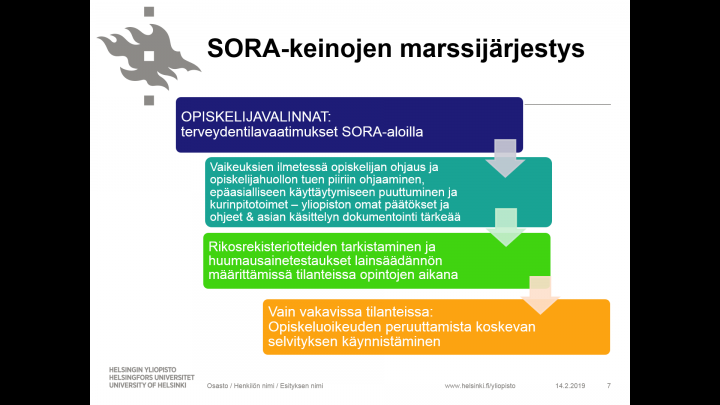
Order of SORA measures

SORA-keinojen marssijärjestys

Drug tests

Under certain conditions specified in the Universities Act, the university may require a student to present a certificate of drug testing. If

  • the teacher has justified reason to suspect that a student is under the influence of drugs during practical tasks or a traineeship conducted as part of their studies, or that the student is suffering from drug addiction, and
  • drug testing is necessary to verify the student’s ability to function, and
  • the student has duties that require precision, reliability, the ability to make decisions independently and good reactivity, and
  • acting under the influence of drugs or drug addiction is posing a serious threat to the life or health of the student or another person, or to the security or integrity of confidential information, or it is significantly increasing the risk of the illegal distribution and trade of substances referred to in the Narcotics Act and currently in the possession of the university or the trainee’s employer,

the university may require the student to present a drug testing certificate. If any suspicions arise, please contact the Head of Academic Affairs of your faculty.

Expiration of right of study for other reasons

Revocation of the right of study differs from the expiration of the right of study due to, for example, delays in studies. If a student asks you about the expiration of their right of study and applying for extension, you can direct them to the Instructions for Students. The faculty may decide to grant an extension to the right of study once the student has applied for it.

See also the Instructions for Students

You will find related content for students in the Studies Service.