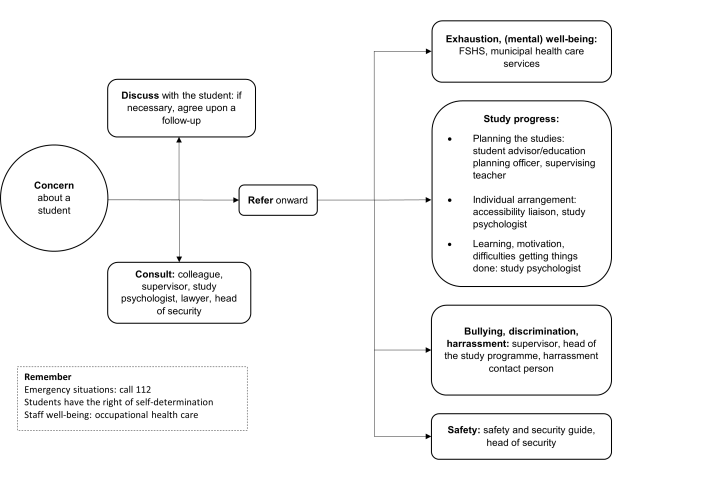
Sometimes, supervision situations give rise to extensive concern about the student’s wellbeing. Such concerns typically arise in situations where a student acts strangely or reacts unexpectedly and seems to be unwell. If you are concerned about a student, you can approach the topic by explaining your thoughts: “I have been wondering how you are doing…”. In matters that raise concern, you can consult a study psychologist.
Students can feel mistreated, bullied or discriminated against. You should always take such claims seriously, for example by explaining that the University has a zero tolerance policy against bullying/discrimination and related matters can be discussed with one of the University’s harassment contact persons or equality advisers. The University also has a lawyer who can be consulted about legal issues related to supervision.
Students can act in a disorderly or inappropriate manner in a supervision situation. For example, they may shout, make false accusations or send inappropriate emails. In a group of students, one student may target others. The supervisor can ask the student to stop this inappropriate behaviour and, if the situation persists, request they leave. If you receive an inappropriate email, you can let the student know that you will not respond to such messages. For more information, please see the University’s instructions for responsible interaction in the University community.
Situations sometimes escalate and become critical. Students may exhibit aggressive or even threatening behaviour that gives rise to concerns about whether you can cope with their frustrations and remain safe. If this happens, it is important that the supervisor keeps calm and does not respond in an equally threatening way. If you are aware beforehand that the situation might become critical, move the meeting to a room with an easy escape route, such as a room with two doors, and ask another person to join the situation. Safety officers are in charge of offering more information about and coordinating safety matters at the University. You can also ask one of the porters to be present. In an emergency, dial 112.
In challenging or demanding situations, it is important to take care of your own well-being. In such situations, it is not advisable to be left alone; rather, it is important to consult a colleague, a supervisor, and/or a study psychologist. If the situation continues to trouble you, you can contact your occupational health services.
The attached chart (PDF) presents the steps to take in an alarming situation. Follow the arrows in the chart to see where you can find support and how to guide the student.